The Pickpocket, the Airport Strike, and the Dripping Suitcase

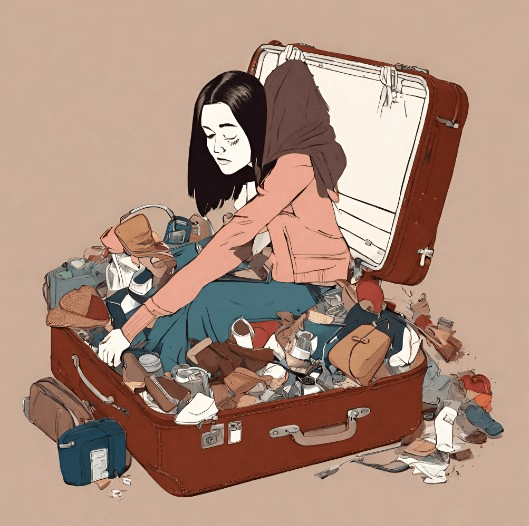
She’s inside the suitcase because image generators are brilliant idiots. (Illustration by Canva’s Magic Media generator; same for all uncredited images below.)

My first mistake was traveling light – that is, heavy, but jammed into tiny bags. I sit on my lilliputian suitcase, fumble with the zipper, and listen to the minutes whizz off towards takeoff. The dozen invisible smokers who had shared my bed for the past four days shake their heads in morose unison; my second mistake had been forgetting that in France, “smoking allowed” rentals aren’t just something with which you scare children.

When I finally run out the door, Google Maps tells me to travel diagonally through a locked building. Ten minutes later, I have safely teleported myself onto a train, which grinds to a halt at the next station. “We will be stopped here for some minutes,” the conductor offers. 

Floor plan of Châtelet les Halles train station. (M.C. Escher, House of Stairs)

I pull up Uber on my phone – it looks like I might still make it – and step off the train. Its one pesky passenger safely deposited, it immediately leaves the station. No matter, Uber is faster anyway. I search for the station exit. The underground stretches for miles. Every direction has exit signs, so I pick one at random and follow it up an endless series of corridors filled with moving walkways, all broken. 

By the time I reach the surface, I have no phone. Not in my backpack, and not in any of my three pairs of overstuffed pockets – two fleeces and one jacket, none of which would fit in my suitcase. 

I catch the next train. I miss my flight, of course, so I book a new one for tomorrow (goodbye, work holiday party), order a new Airbnb near the airport, note down transit directions using pen and paper, and pull up Find my iPhone on my laptop. The phone appears to be lying motionless in a fixed location near where I lost it, scared but unharmed. I decide to return to the station to investigate; I have a day to kill, after all. 

The lady at the subway information booth takes down my description of the phone (the very informative “black with a black case”), apparently entering it into some sort of database. “Ah, it’s not here, it’s at the other information booth, the one for the Metro,” she concludes. 

At the Metro booth, a stone-faced gentleman raises a skeptical eyebrow. He grudgingly heads to the back of the room, appears to open some drawers, then returns, glaring. “Did you say the phone is here, or just might be?” “I don’t… The lady over there said…” 

“It’s always the same story,” he cuts me off. “Every time, you say the lady said there’s a phone, but there is no phone. There is never a phone.” 

The metro-booth gentleman looked exactly like this.

For a moment, I believe him. I have been wandering through the Paris underground for decades, fruitlessly searching for the one thing, the one phone, that will grant me eternal rest. Every day, I shuffle between the lady on the train side and the gentleman on the Metro side; every day, she says there is a phone and he says there is none. 

I snap out of it. “It wasn’t me -” I start, then remind myself that anger rarely works. “Look,” I plead, trying to meet his eyes, “I’m having a really bad day. Could you try to be nicer to me?” 

He looks like it’s the first time he’s heard of such a thing. “I guess… I could try,” he responds, dubiously. Then his voice turns to ice again, and he continues: “but it’s always the same story…”

I leave him to his looping life, then buy another ticket – the only way to get through the turnstiles separating me from the first information booth. By the time I return, the lady I had talked to has evaporated, replaced by three people who have never heard of cell phones. At least they show me how to connect to the subway WiFi. Maybe I can use my GPS to find the phone myself? I open my laptop. The location flickers on the screen in the same spot as last time, near the McDonald’s in the shopping center connected to the underground. Then the laptop battery dies. 
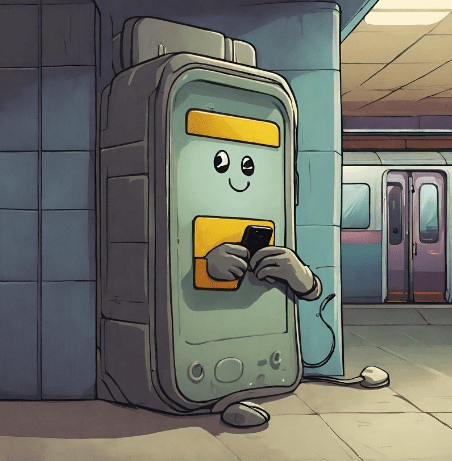
“An anthropomorphic cellphone hiding in the corner of a subway station.” Umm… Inventive hiding spot?

I decide to search for an outlet at the Macdoe – to use the local term of endearment. “Beware of pickpockets,” the subway PA system warns, belatedly. “Keep electronic devices safely stowed.” So it was probably a thief. But then why is the phone in a fixed location? 

I fantasize about using my GPS to ambush the crook at the Macdoe. He’ll be smugly sipping a coffee, so sure of himself that he hasn’t even budged an inch from the crime scene, but my ultra-precise GPS will track him down to that inch. I’ll sneak up right behind him, then pull out the secret weapon: the Play a Sound function. “That man stole my phone!” I’ll exclaim triumphantly, pointing a finger towards the bastard from whose hand will emanate the indubitably incriminating jingle, as onlookers gasp and join forces to surround him…

I have reached the top of the escalator. The Macdoe has no outlets, but suddenly I’m starving, so I stop for a hamburger anyway. Both of my bank cards decline.

I head to the KFC next door. Both of my bank cards decline at the self-service kiosk, but when I come up to the counter to ask for help, it turns out the problem wasn’t the cards at all. They’re just out of quinoa raclette salad. Wait, out of what? Welcome to Kentucky French Chicken. I order a regular salad with chicken tenders on the side.

I find an outlet while I wait, but my charger is burdened with a heavy adapter and keeps plummeting out of the socket. I prop it up with a plastic water bottle, which slows the plummeting to an occasional plop. My phone is still sending out distress signals from the same location. I fantasize about using the GPS to find the Paris underbelly’s secret lair, the chamber where all the innocent phones are bound and tortured, but the uncertainty radius on the GPS spans half a (subterranean) block. 

The regular salad is just a pile of leaves, but the dressing – a rich, buttery, deep-bodied reduction with hints of bleu cheese and a bright nutty finish – is a culinary marvel.

I find a website listing a contact number for the station’s lost and found, get $5 worth of Skype phone credits, dial the number with and without the French country code. I get “invalid number” both times. I give up and gather the chicken bones. “We throw compostables to the left, trash to the right,” enjoins the patronizing French trashcan. I throw everything to the right, because freedom.   

I head down a handful of corridors – without a moving walkway in sight – and return to the platform. I glance at the station’s name again. Châtelet les Halles. Pronounced Paris Pickpocket Central – plain to see once you ignore all the silent letters. 

The phone was stolen but it’s in a fixed location… I imagine the thug examining his bounty – a 5-year-old iPhone with a cracked screen – deciding it wasn’t worth his while, and simply tossing it somewhere. I furtively check out every one of the ten trashcans on the platform, then give up and get on the next train towards my Airbnb.
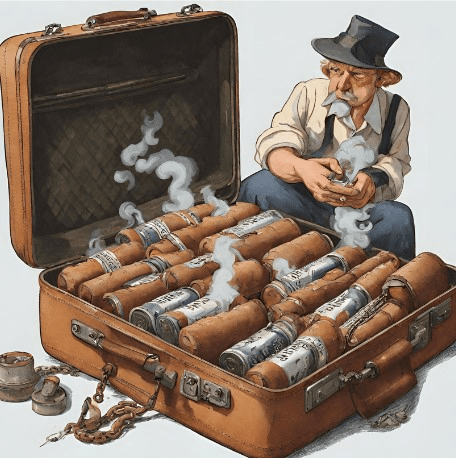
The chain smokers have morphed into a literal chain, but this is still 100% accurate.

The rental is blessedly sterile, but the twelve chain-smokers have all hitched a ride in my suitcase, bundled up in my clothes. I shove them into the washer-dryer, but I can’t find detergent. I’ll just text the Airbnb host… Shoot. I feel a pang of pain in my phantom phone. Ok, I’ll use the WiFi on my laptop… 

If only I had jotted down the WiFi password.  

“Tides Will Turn,” prophesies a decorative sign on the wall – ominously, considering my heretofore nice life. I decide to wash the clothes with plain water. Proud of my modicum of French, I set the machine to the laver et sécher cycle and lock the door. It’ll have to run overnight, but no matter. I’ll start an extra drying cycle in the morning if I have to, after my alarm goes off.

My alarm! My phantom phone howls in anguish. There’s no offline clock on my computer either, no physical alarm clock… 

In a moment of inspiration, I realize that I can just make my own timer, out of driftwood and flint – ok, no, out of the magic of computer programming. import time, I type into my code editor, feeling a powerful current rise up to my fingertips. If only I had had that incantation in the morning… I tell time to sleep for nine hours, then schedule a repeated chime – eternal, unless commanded to stop. The thing sounds like all the phones in the Paris underbelly skinned alive at once, but it’ll do. 

French washer-dryers. (Prompt: Rube Goldberg washing machine)

In the morning, the clothes in the washer-dryer are wet. The machine has sixteen different settings, illustrated with pictograms which require a PhD in hieroglyphics to decipher, but none of them say simply “sécher.” There is a separate “sécher” button, but that only emits an offended beep when pressed. I put the soaking clothes in the suitcase and hope for the best.

The first bus to the airport appears on the street perpendicular the bus stop. It doesn’t slow down when I run after it. I set up an ambush for the second one, outsmart it, and pounce.

The departures board says the flight is delayed by 12 hours. 

I laugh a long, hearty laugh. 

An email from the airline explains that there is a strike at Keflavik airport, which I’m connecting through. They’re giving me several options, they say. The options are all different paths towards a 24-hour delay. To sweeten the deal, they have bestowed me with a 12-euro food voucher, loaded right onto my boarding pass. I make my leisurely way to the nearest café, balancing my laptop in one hand, open to the only boarding pass I have. I feel a twinge in my phantom phone.

My barista.

The barista won’t take my payment method. I gesture at the list of eateries accepting the vouchers, which very clearly includes the present café. By way of response, he bares his fangs and foams at the mouth. I’m about to make my retreat, when a fellow passenger standing in line behind me explains that I’m supposed to get a physical voucher at the check-in counter. 

The lady at the check-in desk says she doesn’t work for my airline. “So where do I go?” “My colleagues,” she explains, gesturing at a series of empty counters.

I buy a coffee (with my own money), then take a seat in the waiting area and start booking another night at the same Airbnb. I suddenly notice that my backpack is lying in a puddle. I curse the airport’s incompetence, then locate the spill’s epicenter – directly beneath my dripping suitcase.

As within, so without, quoth the preposition-challenged AI.

A blessedly familiar sound distracts me from the flood. “And all the airline staff are on strike, so there isn’t even anyone to ask!” I hear next to me, in lovely plaintive American English. I meet the eyes of the suffering soul – the mother in a family of four – and make sympathetic gestures. “Are you dealing with the same thing?” she asks. “We never got the email with the link to our options after the delay… But the airline staff are all on strike, so there’s no one to tell that to.”

“Have you tried logging into your account on the airline website?” I offer. “Nothing works anymore,” she replies tearfully. “I can’t even connect to the WiFi.” “Try turning it off and then on again… No good? What about typing in captive.apple.com into the navigation bar? That sometimes tricks the browser into giving you the WiFi login screen…” “It worked! But now the website is in French…” she continues, her voice dramatically rising and falling with the narrative arc of her utterances. “Try putting /en at the end of the URL. No, forward slash.” “Are you an engineer?” she asks, a notch calmer and brighter. 

Once I know for sure that I’ll never get out of this airport, I decide, I’ll feed myself by providing tech support to frazzled expats. They’ll pay me hundreds of euros for my expertise and, especially, my humanity. I snap out of it. “I am – how did you know?”

“I only learned to code a couple of years ago,” I continue, with all the gregariousness of someone freed from the burden of verb conjugation. “I was studying philosophy before then – you know, trying to figure out if I even knew I existed.” “I get that!” My new friend has completely perked up by now. “Sometimes my life is so repetitive, just the same tasks over and over and over, that I wonder if any of it is really real.” 

An airline staff member appears out of nowhere and offers us vouchers. I mop up the spill beneath my suitcase again.

“It seems you travel a lot?” my friend inquires. I think of delayed flights and missed connections: the day in Santiago; two days on the wrong island of Cape Verde, without luggage; the day in Lisbon, twice. “I was born in an airport and I’ll die in an airport,” I reply cheerfully. 

On the bus to the Airbnb, “Stop Requested” lights flash periodically. There are no stop-requesting buttons anywhere. The driver refuses to let me out without the special signal. I plead with him for several blocks before he halts, sulkily, and opens the door.

My suitcase laughs so hard it pees itself. In a torture chamber deep beneath the streets of Paris, my phone sends out its final distress call.

😀

This post is obviously a little hyperbolic at the the sentence level (e.g. the people at the information booth had, in fact, heard of cell phones), but the sequence of events is 100% accurate.
The Shell Island of Fadiouth

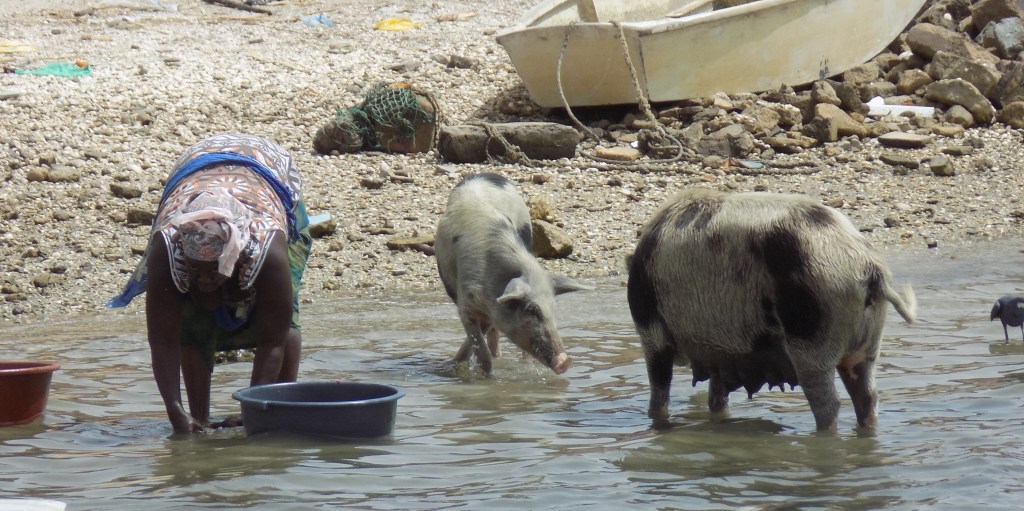
The first thing I see on the Senegalese island of Fadiouth are the wading pigs. The first thing I remember seeing. Only the camera has recorded the woman who wades beside the swine.

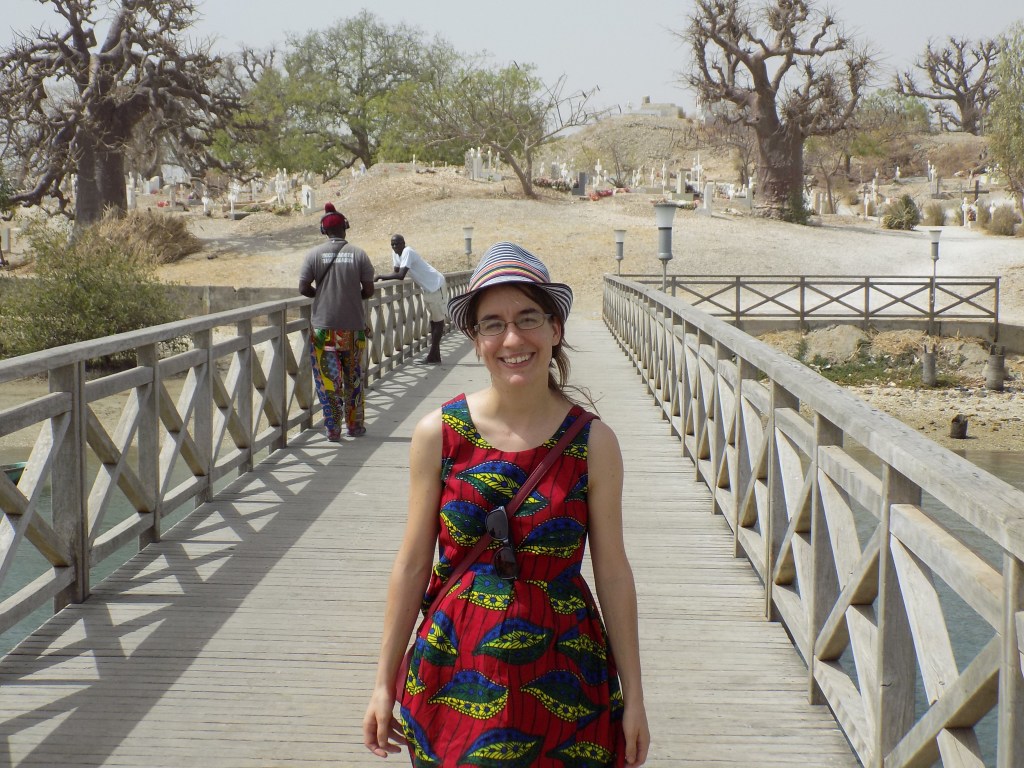
“God willing, you’ll return here for your wedding,” our guide, Jean-Paul, tells Ben and me as we cross the bridge leading to the island. Ben’s dad looks on without comment.

In my memory, Jean-Paul is wearing a Senegalese outfit quilted from thin, multicolored stripes of patterned fabric. In reality, he sports a polo shirt above his quilted pants, and a woolly red hat and headphones above that. The large cross around his neck proclaims that he’s as Catholic as his namesake pope; he appears keen to share a religion with us. He already shares it with 90% of the inhabitants of Fadiouth – an island of Christianity in a predominantly Muslim nation.

Christianity explains Fadiouth’s substitution of pigs for Senegal’s omnipresent goats. Clams explain the pigs’ partial submersion: the animals are digging for food. The local pork, Jean-Paul reveals, is naturally salty.

In fact, clams explain the entre island, built over centuries from discarded shells. For a moment, I’m skeptical: where did the first clam-eater stand before there was an island? All I can see of the ground is scalloped whiteness, yes, but what if this is only the outer layer – the shell, if you will – above a pile of ordinary dirt?

Then, I remember the tide. My skepticism washes away; we walk on. The detritus of history crunches underfoot.


This image has an empty alt attribute; its file name is dscn3714.jpg

At first glance, the corrugated-metal church is the least interesting building on the island. I change my mind when I enter: birds perch on the rafters, singing angelically. I imagine my childhood priest regarding these feathered desecrators with horror; then, I visualize St Francis rubbing his hands with glee.

As we stop by the holy water, Jean-Paul asks if we’re Christian. We all shake our heads; I’m not feel like bringing up my Catholic heritage. “Can I give you a blessing?” he asks. We nod and are besprinkled; his prayer goes on forever. I want to get going, learn things I don’t already know.

“God willing, you’ll come back here for your wedding,” Jean-Paul. repeats as he takes our picture at the front of the church. “God willing,” Ben’s dad nods, deadpan.

And then: “Today was a big day for you: the day of your baptism.”

I imagine my godlessness flowing out of me and into the body of the pig, still submerged in its unholy waters.

This image has an empty alt attribute; its file name is dscn3711-2.jpg

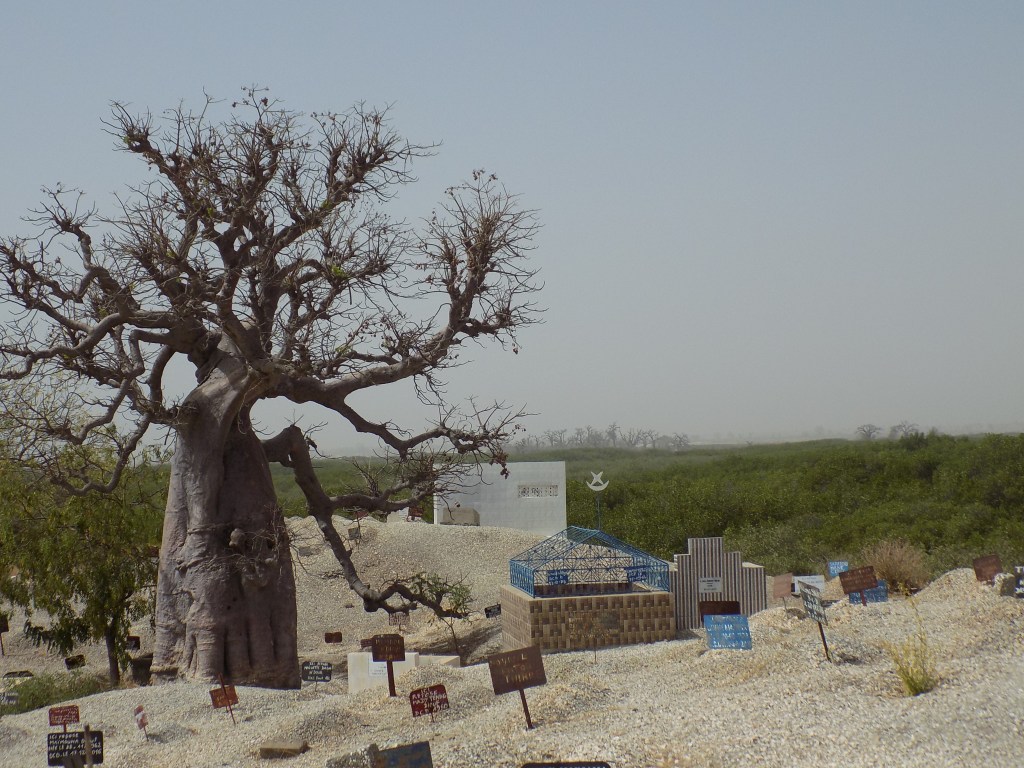
On the cemetery island (connected to Fadiouth by a bridge), crosses, shells, and baobabs combine into austere perfection against a glistening, watery backdrop. I wouldn’t mind resting here myself. In one area, little plaques substitute for crosses; Jean-Paul proudly explains that Muslims lie beside Christians in this cemetery.

At the exit, he lifts up what appears to be a little pouch which had been hanging on the gate. His circumcision charm, he explains. “I am a Christian; I am from the Serere tribe. I keep both customs, but they don’t mix. I leave the tribal here; what is non-Christian stays off Fadiouth.”

I don’t see any other charms in the cemetery, and for a moment, I’m skeptical again. What if Jean-Paul is performing his Serere traditions the way his ancestors performed Christianity: to appease the white foreigners?

No, Jean-Paul, I believe you. I know so little about you, but I do know this: your polo shirt and your rainbow pants, your charm and your cross – all are yours.

This image has an empty alt attribute; its file name is dscn3720.jpg


If you enjoyed this story, you might like Three Boys and a Suitcase (a small meditation on walks through Dakar), or Between Scam and Symbol: Gorée Island’s House of Slaves (which partly explains my skepticism towards tour guides.) And if you’d like to receive future essays in your inbox, sign up for my mailing list below.

Processing…
Success! You're on the list.

Three Boys and a Suitcase: Sketches from Dakar

Sometimes moving to a new place means noticing more. You appreciate everything, take in the smallest details — the light falling on the river, the split-second delight on the face of the children passing by, holding ice cream. Your vision sharpens; you catch every nuance you would have missed at home.

When I moved to Dakar, this didn’t happen to me. Instead, during the first few months, I was almost entirely blind. I saw splotches of color walking the street, things whose name was only “new.” I didn’t venture out much — I’d get overwhelmed after a block, lost after two. I didn’t look at people while I walked; their looking back felt threatening. Thinking I wanted a ride, taxi drivers would honk at me twenty times on one walk. I’d get exhausted just from shaking my head.

Now, after three months, I’m starting to see. The pale pastel houses. The dark, dense, dear trees. The mosaic sidewalks, crumbling round the edges, that aren’t really for walking. They’re for setting up your fruit stand, sitting to chat with your neighbor, parking your car, ducking when a honking taxi prevents from walking on the sandy street. A sort of extended doormat, a different color for each home, they belong less to the pedestrians and more to the houses. Sometimes a tree or a car takes up half the sidewalk. Sometimes there’s a barrier right through the middle, separating one pattern of mosaic from the next.

I see all these things now. Dakar is a place, a stable backdrop to daily life. It has an atmosphere. Tufty clouds; strong contrasts of light and shade; warmth on your skin. The sweet smell of incense — a newness in the air felt the moment I arrived here, but only noticed when a guidebook named it. Fruit sellers’ melodic chants of the names of their offerings. Children singing. Goats bleating.

The people, though, still blur and disappear. Every moment in a taxi is a revelation — lost the next instant. A grain of Sahara sand falling through my fingers. The colorful clothes — yellow and turquoise, pink and purple, checkered, striped, polka-dotted, everything in between. I wish I could paint each one, but they vanish before I’ve so much as seen the pattern. And the people in the clothes? I lack the eyes to see them. Each face is characteristic — and forgotten as soon as it’s seen. A rounded profile; a glint of an earring; a toothy grin. That’s as far as I’ve gotten. I see the sunlight on a face and not the face.

But I’m learning. On my walk today, I saw whole tableaux. A woman in a colorfully speckled dress carried a child on her back. Only the little girl’s head was visible, and her hair was studded with colorful clips, extending the pattern on the dress. Two boys, five or six years old, were the best of friends, arms draped round each other’s shoulders. Three others played with a suitcase — one sitting inside, another pulling it like a stroller or a wheelbarrow. Then they started zipping it up; the little boy, grinning, fit almost entirely inside.

Little boy, I know this delight too. I also grew up huddled around a suitcase, waiting for the next journey to sweep me across the ocean. I also have this joy: to find a snug corner someplace you’re not meant to fit. A pillow fort, a tree branch, a clearing in a forest.

A suitcase. A small scene in a foreign land.

Between Scam and Symbol

Gorée Island’s “House of Slaves”

View from the “House of Slaves.”

Delightful little pastel homes, with bougainvilleas tucked into every corner, the sea sparkling at the ends of narrow, dappled streets. Inside one such delightful home, painted a cheerful pink: narrow, grey-walled cells, heavy with the memory of pain. Above the door of each separate cell, a label made of shreds of the word “family:” men to the right, women — left, children — in the middle. And in a tiny cubicle, shreds of “human being:” “recalcitrant prisoners.”

This is the story I would have liked to tell you about Senegal’s Gorée Island. I would have strolled, then paced, around this tiny (less than half a square kilometer) patch of land, shifting my gaze from the lovely, pastel surface of colonialism to its dark and bloody underbelly, both in full view here. I would have considered, on the one hand, the handful of Europeans in their flowery houses and, on the other, the millions of enslaved Africans said to have passed through this island. I would have felt uncomfortable and horrified and moved; you would have appreciated my intricate descriptions of subtle emotional shifts.

Two uncooperative factors stand in the way of that story: my emotions — and historical facts.

My feelings are more receptive to the joy bouncing off a patch of bougainvilleas than to the faint must of suffering which hangs around an empty cell — especially if that cell is labelled only in a foreign language. As to the facts: the number of slaves shipped out of Gorée Island is the subject of historical controversy and may have been as “low” as 300 per year. A tour guide at the so-called House of Slaves, with those cells labelled “recalcitrant prisoners,” might tell you that a total of a million enslaved people had waited to be shipped across the Atlantic from here. Historians’ estimate hovers around… zero.

Instead, then, let me tell you a story of politics, gullibility, and tourism. A story of the power — and failings — of human emotions. A story too complex to be captured in the single compelling image of a pastel-colored home.

The Door of No Return

As we entered the House of Slaves, I held in my mind the pieces of information I’d gathered about this place during the previous night’s cursory glance at the internet.

  • It was a holding place for slaves waiting to be shipped across the Atlantic.
  • There was some controversy about the exact numbers of people held captive here.
  • With a 4.5 star rating, Trip Advisor ranks it as the #1 thing to see in Dakar.
  • Most of the commenters on Trip Advisor were profoundly moved by the place, which brought the horrors of slavery to all-too-vivid life for them.

I wasn’t one of those people. My feelings failed me, and I found the House of Slaves… beautiful. And empty. The labelled cells were indistinguishable from countless dungeons I’d seen in British medieval castles. I understood that this was a terrible place, of course — but I couldn’t understand the visitors who were moved to tears by their visit.

If we’d done a bit more research, Ben and I would have known that the doorway towards the sea — a tiny blue rectangle flanked on the side by two imposing flights of stairs, through which we gleefully scrambled out onto the wall below — was called the “Door of No Return” and was supposed to be the gate through which slaves were made to embark on their tragic westward journeys. Instead, after climbing out the little door, Ben smiled approvingly at the breeze’s expert hair-tousling, while I leaned back a little over the sea to catch the sunlight on my face.

I’d read a couple blog posts about people’s experiences in Gorée, and everyone said they “made friends”… Everywhere you go here — starting with the ferry terminal — you’re pounced on by would-be tourguides.

I’m afraid we’re not friend-making types.

If we had been, we would have probably paid a guide to fill the cells with affecting stories for us. Instead, we tried deciphering the French signs in the single-room exhibition for a while, then headed back to the sunlit bougainvilleas.

The Door of No Return.

Siding with the “Slavery Deniers”

Gorée Island is listed on the UNESCO world heritage list. On the UNESCO website, we can read that “from the 15th to the 19th century, it was the largest slave-trading centre on the African coast.” The BBC and The New York Times have both claimed that millions of slaves had been held here. Celebrities like Pope John Paul II, Nelson Mandela, and multiple US presidents, as well as (according to Wikipedia) 200 000 visitors every year, have visited not only Gorée Island but also its House of Slaves. Judging by Trip Advisor reviews, most, like me, come to the island under the impression that Gorée really did play a major role in the trans-Atlantic slave trade, and the House of Slaves really did house slaves waiting to be exported.

Other sources paint a completely different picture. The Telegraph quotes historian Ralph Austen:

There are literally no historians who believe the Slave House is what they’re claiming it to be, or that believe Goree was statistically significant in terms of the slave trade.

Philip Curtin’s statistical analysis of documentation of trans-Atlantic voyages suggests that no more than 300 slaves departed from Goree each year. Similar numbers appear to be backed up by the Du Bois Institute’s Trans-Atlantic Slave Trade Database (as reported and further backed up here).

When this data was publicized in a 1996 article in the French press, Senegalese historians were outraged. Here’s historian Mbaye Gueye:

It is true that the slave trade has never been among the preoccupations of European historians, but this was nothing less than an attempt to falsify the past. There are evidently still people who simply wish to absolve themselves of this past.

Mbaye Gueye claimed to have more than ad hominem attacks up his sleeve — he apparently found “original archives from the French port of Nantes that showed that between 1763 and 1775 alone one port had traded more than 103,000 slaves from Goree” (the quote is from the same NYT article.)

This is the one (initially) solid-looking piece of evidence I’ve been able to find for the Gorée-as-slave-trade-center theory — but even this crumbles under scrutiny. In a footnote in this article, we read that the numbers in the Nantes records were for trades brought in from all of West Africa. Gorée isn’t mentioned in them at all.¹

As far I’ve been able to verify, then, Gorée was hardly the slave-trading center that UNESCO makes it out to be. As to the so-called Slave House, it was:

  • in the area of the island populated by rich free people (and, sometimes, their domestic slaves),
  • facing out to a treacherous part of the coast that ships probably wouldn’t have departed from,
  • built after the zenith of the slave trade.

Not every horrific slave story is a true story.

The True Story

If the House of Slaves wasn’t a holding pen for America-bound slaves, what was it? The house, built around 1776, belonged to the Pépins, a family of rich merchants of mixed Afro-European descent.

The most famous member of the family, Anne Pépin, was the mistress of Senegal’s French governor Stanislas de Boufflers, who according to Wikipedia “attempted to mitigate the horrors of the slave trade.” Anne Pépin was one of the so-called “Signares:” African and Afro-European women who had formed relationship with powerful white male invaders, and who often worked as merchants and owned land and slaves.²

What should we think of the Signares? Were they feminist icons, black women who managed to wield considerable power in an era where that would have hardly seemed possible? Or femmes fatales who used their sex appeal to their advantage and didn’t shy away from the slave trade, buying and selling their own kinsmen? Were they the victims of the lust and power of male European invaders, who eloped with them only to leave them behind and sail off to Europe, often back to the wives they had left behind? Were they just making the best of an awful situation, using their influence to ensure better treatment of their partners’ domestic slaves — or were they heedless of the suffering they contributed to, driven by the pursuit of wealth and power?

The answer may well be: all of the above. The human soul is a complex place — but that doesn’t bring in tourists. Can you blame the people of Senegal for not broadcasting the story of these mixed-race slave-owning badass island ladies? Can you blame them for, instead, feeding visitors the thrillingly familiar story of easily condemnable attrocities hidden in the dungeons of a pastel town? After all, the House of Slaves is Senegal’s top tourist destination, and its historically inaccurate story has forty years of bestseller status speaking in its favor.

Anne Pépin and her family didn’t keep slaves waiting to be shipped across the Atlantic — those were held in a fortress on the other side of the island — but they probably did own so-called indigenous slaves: people kept on the island by force for domestic labor. (It was most likely indigenous slaves who built the Slave House and many other Gorée buildings.) This is another part of the Gorée story that isn’t often told: by the eighteenth century, over half of the island’s population consisted of indigenous slaves. The mistreatment these people endured was just slight enough for us to have erased it from our collective memory.

The “cells” of the House of Slaves, then, were probably the lodgings of indigenous slaves, whose lot, though certainly not enviable, didn’t feature the shackles now exhibited here.

And the Door of No Return? We don’t know for sure, but it may have been… a garbage dump for throwing waste into the sea. (Take this with a grain of salt; the reference is from the UK’s The Daily Mail, which isn’t exactly famous for stellar journalism…)

Where the Myth Came From… and Where It’s Headed

The whole story about the horrors of the House of Slaves seems to have originated with a single person: curator Boubacar Joseph Ndiaye. For forty years, right up to his death at 86, he led daily tours of the house, telling his gory and compelling tale to transfixed audiences.

During those forty years, the House of Slaves and its Door of No Return acquired a cult status. Members of the African diaspora would come here to come to terms with what their ancestors had lived through. (Those who come from the United States are especially unlikely to be retracing their ancestors’ footsteps; the slaves who did pass through Gorée were overwhelming shipped to Europe and South America.)

Since Ndiaye’s death, no one has been proclaiming the myth of Gorée quite so forcefully. More and more visitors are aware of the controversy surrounding the House of Slaves; it’s right there in the Wikipedia article. The Bradt Guide to Senegal cites both the Phil Curtin numbers and the alleged Nantes document, diplomatically concluding “The true numbers may never be known.” In other words: “we don’t want to anger anyone.”

A sign outside the door to the House of Slaves stamped “UNESCO” informs you that the site is “under renovation” to bring it up to 21st century museum standards. There’s no explanation of this mysterious phrase, no grand retraction of the House of Slave’s claim to fame — but the museum is slowly ceasing to be a memorial to the invented horrors of the building it’s housed in and turning into a monument to the very real horrors of the entire trans-Atlantic slave trade.

Rebranding the museum: this mural no longer graces the walls of the House of Slaves. (Source.)

Slowly but surely, Gorée is turning into a symbol. I wish UNESCO openly acknowledged that they’d made a mistake, rather than quietly filing away old signs — but at least the end destination is a noble one. I don’t want people to stop coming here. This tiny, remarkably preserved island is uniquely placed to play the role of an anchor for the imagination.

Ndiaye didn’t really invent the story of the House of Slaves; he simply relocated a true story to this tiny island. The shackles exhibited here weren’t used in this house — but they were certainly used during the horrific forced journey across the Atlantic so many had to endure. Gorée wasn’t the main location of the slave trade — there were many places like it, each with its trickle of atrocities.

In fact, there is a true “door of no return” west of the Atlantic: South Carolina’s Sullivan’s Island, the site of a checkpoint and quarantine house for 40% of the slaves shipped into British North America. Today, Sullivan’s Island is a wealthy beach resort town, with some of the highest real estate prices in the area.

There is a House of Slaves in Gorée for exactly the same reasons for which there isn’t one in Sullivan’s Island: political convenience and monetary gains.

You visit Sullivan’s Island to sunbathe — or to bask in the glory of the American victory which took place there in 1776. You visit Gorée to feel bad — about what you already know.

The next time I walk by a pastel home, I’ll remember to search for its bloody underbelly. It might be small, and complicated, and scarred in the strangest of patterns, but it will be there. After all, if this tiny island can’t hold its millions of slaves, they’ll have to spread out over the rest of the world.

I wish I had been less gullible, but I don’t regret visiting the beautiful, complicated island of Gorée.

[1] Here’s the whole footnote.

Following the I997 conference, articles in the N. Y Times and the newsletter of the U.S. West African Research Center in Dakar (WARA) indicated that Prof. Mbaye Gueye of Cheikh Anta Diop University in Dakar had found archival materials in Nantes that indicated a much larger Goree slave trade. Prof. Gueye showed the author a copy of the relevant document in June 1998; it is a summary of slaving voyages from 1763 to 1775, which add up to 294 ships carrying 103,135 slaves. The only destination indicated is “N. Gulinee” (Upper Guinea), and Gueye simply maintains that Goree, with its excellent harbor, served as a transhipment point for some of the ports in present-day Guinea and the Petite Cote of Senegal (south of Dakar), whose small size and sand bars made them unattractive destinations for ocean-going vessels. This claim is probably true, but the major slave trading outlets of this region were at St. Louis and the Gambia River and would not generally have required such services. (I am grateful to Martin Klein for help with this issue).

[2] The ship which took Obama to Gorée was called “La Signare.”